Core data structures
Build confidence with indexing, references, stacks, queues and complexity.
- Big-O & arrays
- Strings & hashing
- Linked lists
- Stacks, queues, recursion
- Elementary sorting

A focused engineering workspace for machine learning, AI, algorithms and production projects—covering data preparation, model building, evaluation, explainability, APIs, RAG and interview-ready problem solving.
Choose a workspace. Detailed notes and tools open inside the built-in CodeHub browser while the homepage stays clean and professional.
The complete algorithm atlas is projected into color-coded rotating rings. Every algorithm name stored in CodeHub appears in the circulation area. Hover anywhere over the galaxy to pause it, then use the searchable Algorithm Atlas below for definitions, complexity and examples.
Learn in dependency order. Fundamentals first, then reusable patterns, then trees/graphs/DP and advanced range/string techniques.
Build confidence with indexing, references, stacks, queues and complexity.
Recognize the shape of the problem before choosing code.
Master graph algorithms, advanced DP, range queries and string matching.
Use the Kunal track for concept-first Java foundations and the Striver track for structured interview problem practice. The explanations and solution labs below are original companion material; source buttons open the official resources.
Flow, Java setup, I/O, conditionals, loops, functions, scope
Arrays/ArrayList, linear & binary search, modified binary search, elementary + divide-and-conquer sorting
String operations, builders, comparisons, palindrome logic and pattern construction
Prime checks, sieve, factors, modulo, HCF/LCM, Euclidean algorithm, bit operations
Call stack, recursion trees, merge/quick sort, subsets, permutations, maze, N-Queens, Sudoku thinking
Big-O/Theta/Omega, recurrences, divide-and-conquer analysis and auxiliary space
Singly/doubly/circular list, reversal, fast-slow pointers, cycle detection
Stack/queue implementations, circular queue, conversion patterns and interview applications
Binary trees, BST, DFS/BFS, AVL concepts, segment tree and Fenwick tree
Priority queues, heap sort, top-k, k-way merge, hashing, chaining/probing and rolling hash
Sliding window, two pointers, prefix ideas, Kadane and monotonic structures
BFS, DFS, components, MST, Dijkstra, topo sort, Bellman-Ford and all-pairs thinking
Memoization/tabulation, knapsack families, subsequences, string DP and greedy decisions
Trie, advanced number theory, matrix exponentiation, Catalan ideas and decomposition techniques
Each example is written for CodeHub with clear logic, Python, Java and a variable-by-variable dry run. Use the native category dashboard and the worked solution lab on this page; CodeHub explanations and implementations are original companion material.
Track the maximum seen so far.
Keep one write pointer for the next unique value.
Compact non-zero values, then fill the rest with zero.
Store each value's index and check whether its complement has appeared.
Keep the best subarray ending at the current position.
Discard half of a sorted search space after each comparison.
At least one half is sorted; use that fact to decide where target can lie.
Reverse one next pointer at a time while preserving the rest of the list.
Two pointers moving at different speeds meet if a cycle exists.
Match every closing bracket with the most recent unmatched opener.
Process one queue level at a time.
Every unvisited land cell starts one connected-component traversal.
Always expand the currently cheapest known node when edge weights are non-negative.
Ways to reach step i equals ways to reach i-1 plus i-2.
For each item, choose skip or take once.
If characters match, extend the diagonal; otherwise keep the best after skipping one side.
Each edge represents one character; prefixes share nodes.
Process zero-indegree nodes; if all nodes are processed, the dependency graph is acyclic.
A dedicated interview-practice workspace inside CodeHub. Search worked companion problems, open the logic first, compare Python and Java, then dry-run every important variable before marking a problem solved.
CodeHub is an independent companion workspace. Explanations, implementations and dry runs here are original; the source button above opens the official Striver A2Z sheet.
Every deep-dive opens a full lesson with recognition signals, step-by-step logic, complexity, Python, Java, dry run, and interview notes.
Official category roadmap + CodeHub-original explanations, Java/Python solutions and dry runs.
A fast-reference catalog of core and advanced algorithms, data structures, patterns, DP families, graph methods, string algorithms and math techniques.
Chapter-wise GPT-style Machine Learning course from foundations to production ML. Every chapter contains every major sub-concept, easy definition, working process, assumptions, formulas with symbol/parameter names, worked examples, Python code, complete runnable code, line-by-line explanation, dry run, advantages, disadvantages, metrics, use cases, mistakes, revision points and interview Q&A.
One searchable learning system for Python, data, mathematics, statistics, preprocessing, machine learning, deep learning, NLP, computer vision, Transformers, Generative AI, RAG, deployment, MLOps and interview revision. Open any concept for an easy definition, key ideas, formula and interview question.
Search “Logistic Regression”, “SHAP”, “LSTM”, “RAG”, “XGBoost” or “MLflow”. The voice assistant can also open or explain these notes.
Use the same reasoning loop in interviews: understand, model, choose a pattern, prove the logic, trace an example, then implement and test edge cases.
Explain input, output, constraints and edge cases in your own words.
Write the obvious solution first and calculate its complexity.
Sorted? contiguous? repeated lookup? tree? graph? overlapping states?
Select pointers, window, hash, stack, BFS/DFS, greedy, DP, etc.
Trace variables on a tiny example before writing final code.
Explain why each movement/state is safe and test boundaries.
Curated LeetCode-style problems mapped to the exact patterns in the notes. Each button opens the working question + solution page.
Practical projects show how data structures, Python, SQL, ML and deployment skills translate into complete products.

Machine-learning workflow using crop, weather, soil and historical production data.
Python, SQL, KPI, segmentation and business analytics dashboard.
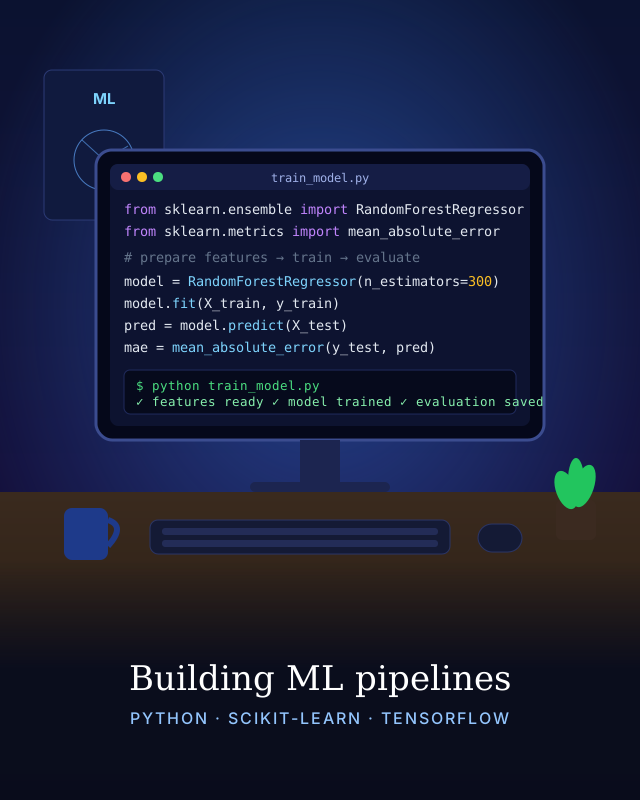
Prediction interface backed by a trained model and API workflow.
Java solutions for high-frequency interview problems and patterns.
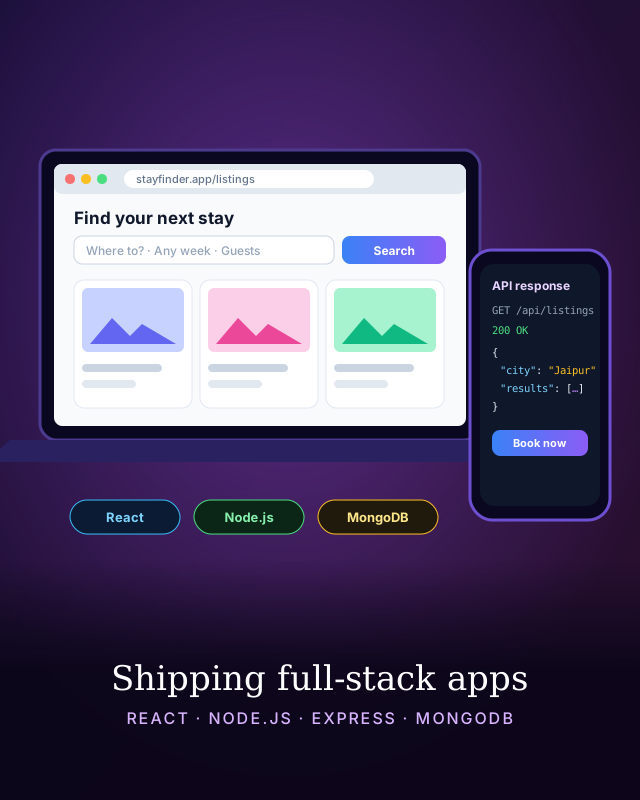
Trading-platform clone demonstrating reusable components and full-stack architecture.
Tourism/stays application covering listings, responsive UI and server workflows.
Visitors stay inside CodeHub. The assistant answers DSA, AIML, project and interview questions immediately. Personal or advanced requests can be prepared for Aamir in the same panel.
Direct contact routes, professional profiles, portfolio, CodeHub and résumé.
Open to AI/ML, data, analyst and software opportunities.